Tuesday, 15 May 2012
Let Osprey...
Although not quite forty days and forty nights, we've had enough rain recently to partly flood the bean field below our garden. This in turn has encouraged a migrating Osprey to set up a temporary home. It can often be seen flying in over the seawall to land on a post with a fish, most likely Bass or Mullet, which it then consumes. This action has not gone unnoticed, the Osprey has on more than one occasion attracted the attention of local Buzzards which perch on adjacent posts, allowing an appreciation of how much larger it is.
Wednesday, 9 May 2012
Ouzel that girl ?
This female Ring Ouzel spent four days in the garden, suffering constant harassment from the territorial local Blackbirds. Ring Ouzels are the mountain equivalent of Blackbirds, breeding in the uplands of the UK and occur here in single figures most years, mainly in autumn on their way to their wintering grounds in north Africa.
On the third day it was briefly joined by a male, which found the local welcoming committees attention too much !
Other migrants are slowly beginning to find their way here bringing the garden list up to 93. These include Blackcap, Chiffchaff and Whitethroat.
It may seem along time ago but there have been a few days when the sun has shone and the temperature risen above 10 degrees ! This warmth prompted the appearance of the first butterflies basking in the sunshine. Amongst them have been Peacock, Comma and Orange Tip.
Another group requiring an increase in temperature before they become active are the reptiles, the first of these to emerge has been the Common Lizard, showing well at times often allowing a close approach.
The 'Conquered Conker' 2012 RIP.
"The answer my friend is blowing in the wind".
Thursday, 29 March 2012
Firestarter....
The day got off to a good start with a pre-breakfast milk run to the dairy, resulting in finding a Firecrest calling from the front garden. These little 'crackers' have occurred twice before in the garden both in spring.
This brings the garden list up to 72 for the year, no doubt this will be boosted shortly by the incoming spring arrivals !
With the recent rise in temperature has come an increase in the number of moths caught in the traps. Along with the expected early season species was this Dotted Chestnut. Although not a new species for the farm, we had our first two last year, it is normally associated with the south and south west of the country though has showed a recent easterly expansion, with the first Essex record in 2002.
The other image is of a Pine Beauty, not a scarce moth, but always welcome to see. It raises the question of where they originate from, as the name suggests the larva feed on pines, which are absent from the immediate area.
Saturday, 17 March 2012
Spring is in the hare !
It's official, with the advent of the first heavyweight bouts between boxing Brown Hare's, Spring is here.
Interestingly it is the female that starts the 'boxing' in an attempt to ward off the amorous advances of the male.
The accompanying sound track to the bouts is often the song of the Skylark, a species that has benefited from the 'Skylark' plots provided under the stewardship schemes.
Also making an appearance are several species of bee, the most obvious being the large queens of the Red-tailed Bumblebee (Bombus lapidarius), which along with the Early Bumblebee (Bombus pratorum) are often the first bumblebee to be encountered during the year.
Always a welcome sight, the first returning Wheatear of the year appeared today. These 'chats' are often the first migrant birds of the Spring to appear on the farm, on their way northwards to breed in 'Breckland' and the uplands of Britain, having wintered south of the Sahara.
Wednesday, 7 March 2012
Circus act
This winter has been a good one for Hen Harriers (Circus cyaneus). Whereas normally only a single individual would been seen during this period, with the help of photography it has been possible to determine that at least five different birds have been present. Four of these have been immature birds known as 'ringtails' and the fifth an adult female. Their presence often being heralded by the scorning of the resident Carrion Crows.
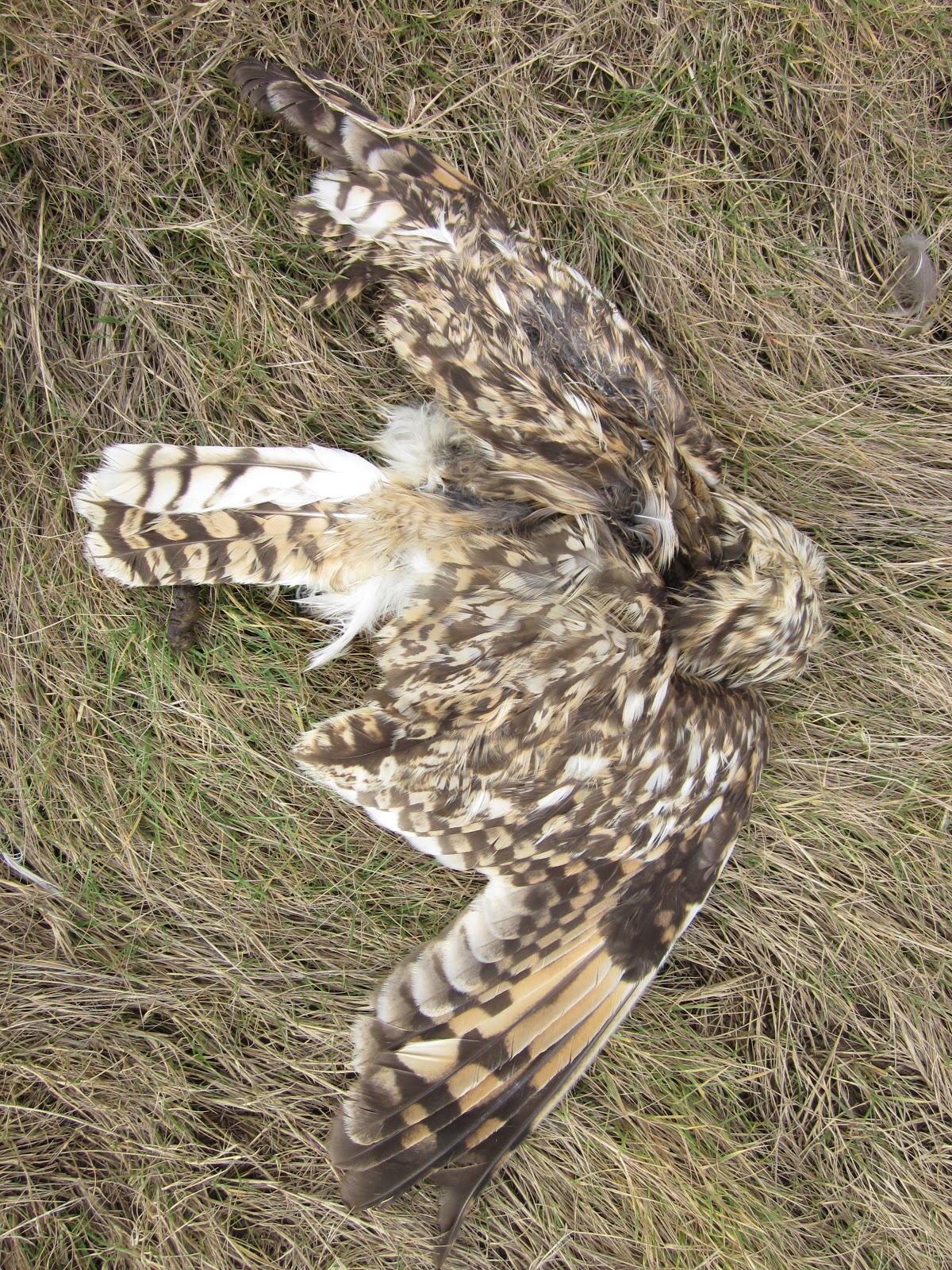
Also doing well are Short eared Owl's, with one site in Essex holding double figures, whilst locally up to seven have been seen across the river from Howland's Marsh. Not so fortunate was this individual that became a victim of overhead wires close to the seawall.
Saturday, 25 February 2012
Underground...overground
Free but not wombling! this moribund Mole was found by the children outside the front of the house. With no obvious signs of having been attacked, it allowed a rare opportunity for a closer view. It was released near to where it was found but sadly didn't recover.
The Harris's Hawk is still at large and being seen occasionally, allowing a close approach at times. Judging by the bulge in it's crop it is feeding well, though i've not yet witnessed it catch any prey.
Sunday, 19 February 2012
Survival
With the recent covering of snow and drop in temperatures, some have been finding it difficult. This Snipe, a ground feeding wader would have found it's cryptic colouring of no use on a white background, coupled with the extra stress of foraging in the frozen soil could have led it more open to predation.
Several Woodcock, a close relative of the Snipe have been seen in the garden and adjacent fields mainly skulking at the base of Blackthorn hedges. It is a familiar bird of late autumn and often associated with hard weather movements, numbers increasing when there is a freeze on the continent. Although they are encountered frequently i have not been able to photograph one on the ground yet !

Other species of bird, notably the small passerines such as Long-tailed Tit have a higher metabolic rate and need to feed more often in colder weather, providing us with a constant stream of visitors to the feeders. Unusually some have taken to feeding under the feeders, taking small particles of peanuts that are dislodged by the others.
Not all are finding it so difficult, this Fox has been several times, casually trotting along, even stopping to take in some of the sun's rays on occasion, no doubt benefiting from the misfortune of others !
Subscribe to:
Posts (Atom)